Katsuo-ji, or the temple of Winning Luck
The Daruma is the avatar I use for Lia Asura, so perhaps it was inevitable that Katsuo-ji would eventually find its way into Divine Debris. It also became particularly important in Book 3, Nine Cursed Objects, where the characters visit Katsuo-ji repeatedly and deal with cursed darumas.
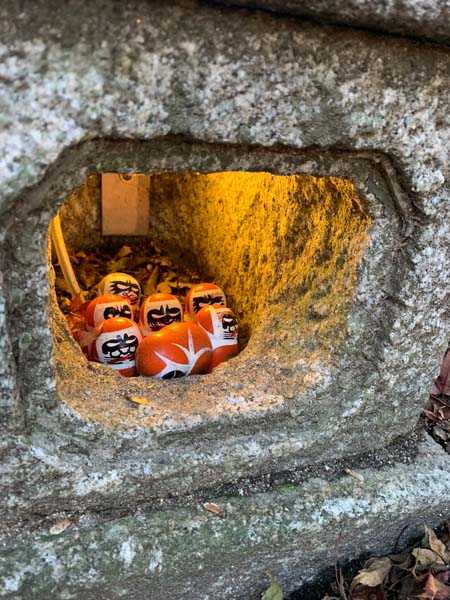
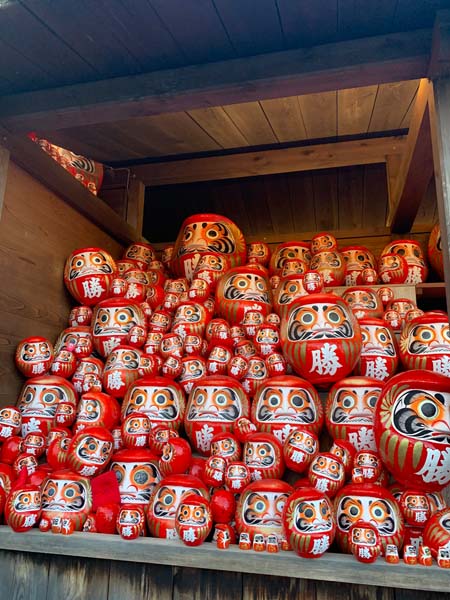
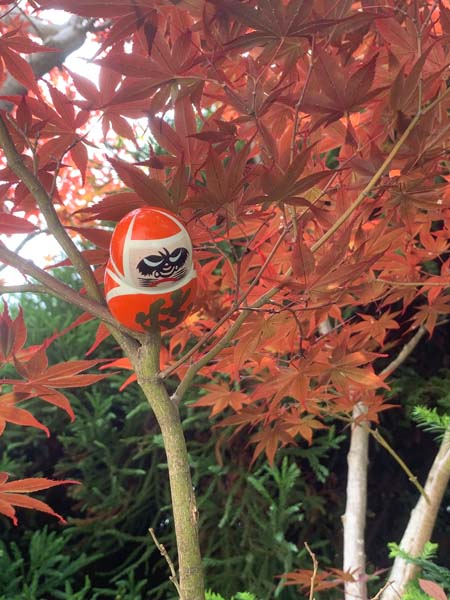
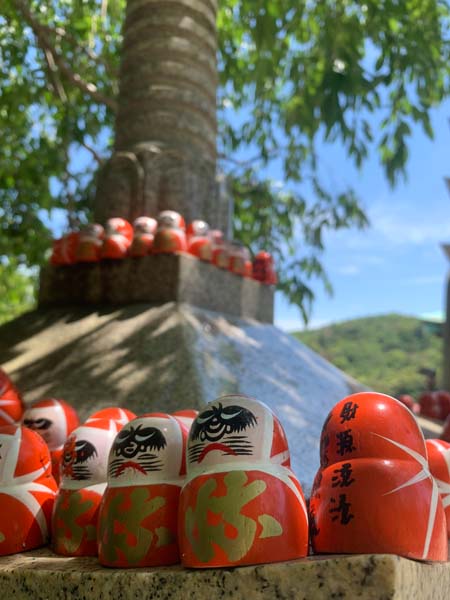
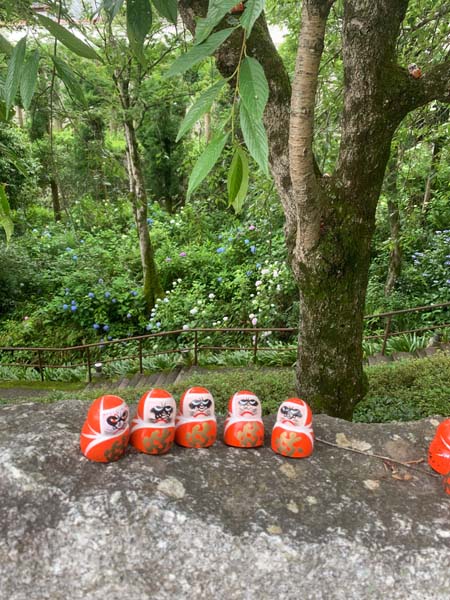
Even if you know nothing about the temple beforehand, it is difficult to miss what makes it famous. Tiny red Daruma dolls are everywhere: sitting on shelves, clustered around trees and walls, gathered in specially designated places and looking out from all sorts of corners of the temple grounds.
Please don't touch them.
They are not there as decorations for visitors to play with. They have been left there by people who bought them, prayed with them and eventually brought them back to the temple. And they bite. (You would think I am lying, but that’s remains to be seen).
The real story behind Daruma is insanely strange. A Daruma represents Bodhidharma, the Indian monk traditionally regarded as the patriarch who brought the teachings that developed into Chan Buddhism in China and, eventually, Zen in Japan. Much of what we know about Bodhidharma comes through later religious tradition and legend rather than reliable contemporary biography, which makes him an interesting figure in his own right.
One of the most famous legends about Bodhidharma says that he spent nine years meditating while facing a wall. The story became an important part of the way Daruma was represented in Japanese art, where he is often shown as a compact figure wrapped in his robes, with little or no visible body beneath them. The familiar round Daruma doll developed in Japan much later, combining this imagery of Bodhidharma with an older tradition of weighted, self-righting toys. Push a Daruma over and it will return upright.
Fall down. Get back up.
That is why the Daruma is so closely associated with the Japanese expression 七転び八起き — “fall seven times, rise eight.” The idea is simple: whatever happens, you get back on your feet and try again.
The blank eyes have their own tradition. A Daruma is commonly purchased without pupils. One eye is painted in when a person makes a wish or sets a goal, and the second is painted when that goal is achieved. The details of the ritual vary depending on the region and tradition, but the basic idea is beautifully simple: the one-eyed Daruma sits there and reminds you that you still have something to accomplish.
Katsuo-ji gives that symbolism a very specific local meaning.
The temple's history goes back to the eighth century. According to its traditional history, two brothers named Zenchu and Zensan came to the mountain in 727 and established a small hermitage for their religious practice. Prince Kaijo later joined them, and the temple that developed from their practice became known as Miroku-ji. In 780, a monk named Myokan is said to have carved the temple's principal statue of Senju Kannon, the Thousand-Armed Kannon.
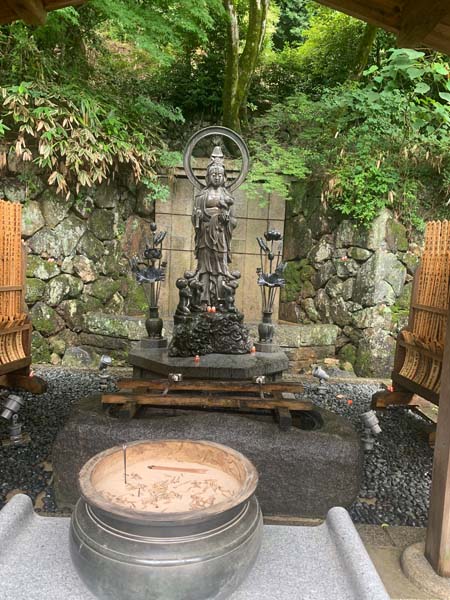
The temple has also had some rather dramatic moments in its history. It was completely destroyed by fire during the Genpei War in 1184 and subsequently rebuilt. Centuries later, the temple became associated with the Jodo founder Honen, who stayed here for several years. Katsuo-ji is also one of the 33 temples of the Saigoku Kannon pilgrimage and belongs to the Koyasan Shingon Buddhist tradition today.
But where did the idea of “winning” come from?
According to the temple's tradition, the sixth abbot, Gyojun, prayed for the recovery of the sick Emperor Seiwa. When the emperor recovered, he was so impressed by the temple's spiritual power that he gave it the name 勝王寺, roughly “the temple that defeats the king.” The monks considered that name too presumptuous, so they changed the character for “king,” 王, to 尾, while keeping the pronunciation. That is how 勝王寺 became 勝尾寺 — Katsuo-ji.
From there grew the temple's association with 勝運, or “winning luck.”
Today people come to Katsuo-ji to pray for success in all sorts of things: examinations, sports, business, personal goals and other difficult challenges. The temple itself emphasizes that “winning” is not necessarily about defeating somebody else. It is about overcoming your own weaknesses.
Which brings us neatly back to the Daruma.
There is another story from the temple's early history that I particularly like. While Kaijo was working on copying Buddhist scriptures, a frightening eight-faced, eight-armed being appeared in a dream and threw away the paper he needed. The temple identified the creature as the local deity Aragami. Two crows subsequently brought instructions explaining how to pacify it, and the monks established a shrine to the deity. The temple describes this figure as a Sanbo Aragami, a fierce guardian of the Three Treasures of Buddhism, who was also believed to drive away illness and troubles.
So even before there were thousands of little Daruma scattered around the grounds, Katsuo-ji already had a history involving fierce supernatural beings, miraculous encounters and religious stories that sit somewhere between mythology, legend and temple history.
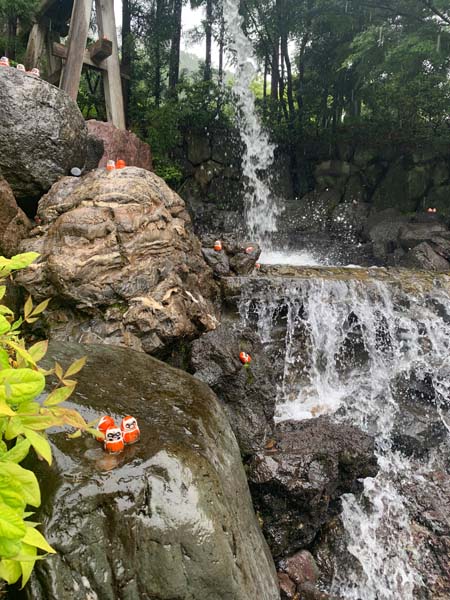
Katsuo-ji is much more crowded than it used to be, particularly during the seasons when the surrounding mountains are at their most spectacular. Yet it remains a beautiful place. The temple sits among the forests of Minoh, and the gardens, ponds, bridges, gates and hillside paths make the Daruma seem almost like part of the landscape.
There are Daruma that have been deliberately arranged for visitors to see, and there are the thousands that people have left after their prayers or wishes. Some are tiny enough to fit in your palm. Others are much larger. Together they create a slightly surreal effect: you keep noticing another little face staring at you from somewhere you weren't expecting.
And yes, they are staring.
Just don't touch them.
They have work to do.
For me, Katsuo-ji is therefore both a real place in Osaka and a place that has become tangled up with the fictional world I have built. The Daruma connects it directly to Lia Asura, while the temple's long history of religious legends, fierce guardian spirits and stories about overcoming adversity makes it an appropriate setting for supernatural mystery.